
Ruth Williams
“My father said, ‘Ruthie, remember in your heart,
when we cut ourselves, everybody’s blood is red.’”
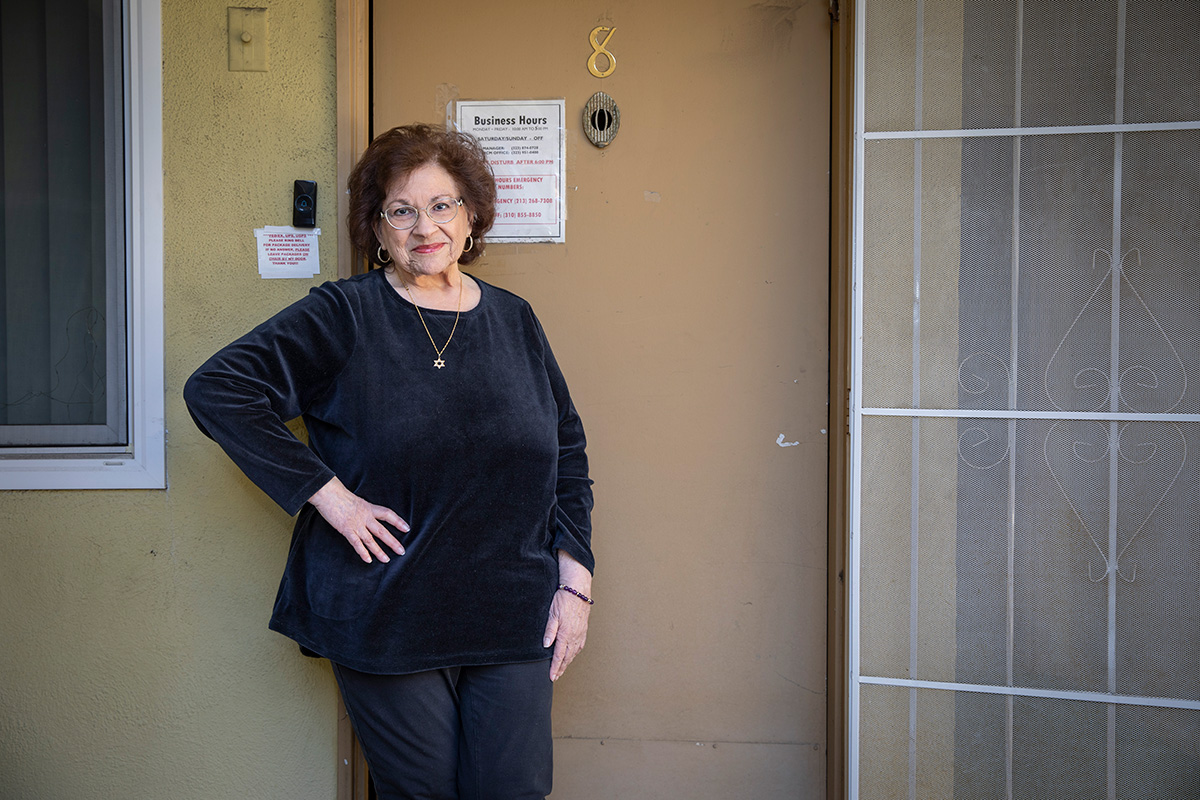
My mother, a one-time dancer in the Ziegfeld Follies, was the person who got me involved with activism. But it was my father who instilled in me my sense of social justice back when I was young and we lived in Phoenixville, Pennsylvania. Because I was Jewish, I was called a Christ killer and a nigger lover because I had a friend who was Black. My father said, “Ruthie, remember in your heart, when we cut ourselves, everybody’s blood is red.” That is when I started caring deeply about the values that West Hollywood embodies. So, when I say my roots are West Hollywood, my roots ARE West Hollywood. West Hollywood is home. It is where I grew up. It’s where I raised my children and where my grandchildren were born.
I first arrived in West Hollywood on August 8, 1948. Growing up, my family lived on the 1200 block of Fuller Avenue in a back guesthouse. Back then, West Hollywood was an urban village. We had neighborhood-friendly businesses. We had block parties with our neighbors. One of my neighbors was in The Wizard of Oz. The great jazz drummer Billy Erskine was a neighbor. As kids, we would go through the hedges, along the back of the homes, to meet in Plummer Park. Everybody knew if you wanted to look for somebody in the neighborhood, you went to Plummer Park.
As a teenager, growing up in West Hollywood was exciting. My friends and I hung out on the Sunset Strip. I remember the scorn on my mom’s face the first time I came home on the back of a motorcycle with a guy wearing a Galloping Goose jacket. My mother said, “What in the hell are you doing?” The Strip was alive with all kinds of clubs and restaurants. We’d go to Schwab’s Pharmacy and Sneeky Pete’s because you never knew who you’d see there. I’d see actors like Natalie Wood and Dean Martin, who were my age.
Even though we weren’t a city yet, our community was already called West Hollywood, and we were known worldwide to be part of the entertainment industry. It was natural for me to work in it. In the mid-1960s, I got a job at Radio Recorders, which was just outside of the WeHo city limits. It used to be the only place to go to make an album because record companies like Columbia, Warner Brothers, and Motown didn’t have recording studios at the time. I was working for $50 or $60 a week as the assistant studio manager. I met all the musicians who were big at the time—Sonny Criss, Andy Williams, Johnny Mathis, Barbra Streisand, and Janis Joplin. My two older sons, Steven and Richard, became friends with Scotty, the son of Mac Davis. Later, I went to work for RCA Records, Motown, and KTLA Television.
In 1971, I moved into the building where I now live because, as a single mom with three kids, I wanted to be near Plummer Park, close to schools, and close to shopping. Two years later, rents started tripling in the area and I was worried about how I would pay my rent if it went up. That’s why I first got involved as an activist in the community. I can’t remember how, but I met renters’ rights activist Norman Chramoff at a small meeting in Plummer Park. He dragged me down to Pico-Union to meet Larry Gross, the director of the Coalition for Economic Survival (CES). I got involved with CES, and we held rallies in Plummer Park to organize renters and bussed down to the Los Angeles County Board of Supervisors to fight for rent control. And we won. But the L.A. County rent control law was set to expire in 1985, so we started organizing for a 1984 ballot measure to form our own city, thinking that Cityhood would be the best way to protect us. I set up a meeting in my apartment between Larry Gross and my friend Bill Press, who was a well-respected liberal media commentator, thinking he could help us assess whether Cityhood could work. He thought it was feasible. Then I asked Frank Wittenberg, a homeowner on Greenacre Avenue, what he thought. He had tried Cityhood a while before, and he said he didn’t think it would work. But we decided to move forward with the ballot measure. That’s when Ron Stone and Bob Craig, gay activists, got involved in the Cityhood movement. We worked together on the Incorporation Committee. When Cityhood got on the ballot, we needed to elect councilmembers at the same time, and I decided to run.
The night that Cityhood won was a glorious night, even though I lost as a candidate for City Council. Cityhood meant freedom and that we could control our own destiny. It meant that we could keep our homes. It meant that we could start taking control of development. But all of a sudden, we’ve got this city. What do we do with it now? We didn't even know where City Hall was going to be. We had to have things like a city manager. At the time, West Hollywood got hit hard by AIDS. I could see what this disease was doing to people, how friends were dying. I remember organizing a march on Sacramento with people like Bob Craig, Zeke Zeidler, and Ivy Bottini. So many people are gone now because of AIDS.
Thank God for people who served on the City Council like John Heilman and Abbe Land, who got what it meant to protect the citizens of the City—not just with rent control—but with social services and antidiscrimination laws. Actually, we’ve been at the forefront of every major issue of our time. Look what Abbe did, making us the very first city to ban Saturday night special handguns. Who’da thunk? I think we’ve set very high standards for other cities and governments to realize. I think we have made a difference.
I’ve stayed involved with the City over the years. In the early years, I served as a Rent Stabilization Commissioner. Then, when there was talk about replacing the Sheriff’s Department with our own police force, I started the group Save Our Sheriff (SOS). I was terrified to think that public safety would become politicized, so I brought together every faction of the city—landlords, renters, homeowners, and the business community—to fight it. The idea died in Council but surprise, surprise. A few years later in 1992, a group placed an initiative on the ballot to create a West Hollywood Police Department, claiming that the sheriff’s deputies were too homophobic. I took a three-month leave from my job to work on the campaign.
After we defeated the ballot measure, Councilmember Steve Schulte and I came up with the idea to create a City of West Hollywood Public Safety Commission to give the community a platform to voice its concerns with the Sheriff’s Department. As of 2019, I have been on the commission for twenty-seven years. I’m also chair of the Fairfax Business Association, served on the board of Stonewall Democratic Club, and was chair of the Project Area Committee to redevelop the eastside of town. The West Hollywood Gateway commercial development was the first project that we did; then we did The Dylan, a mixed-use housing and retail complex.
Some businesses that had to leave during construction couldn't afford to return. We overpriced ourselves. For a while, I was very involved in a residents’ group called Good Neighbors. Although the group was initially formed to attack the City, when the founders moved away, I said, “Let’s turn it into something good.” For many years, I organized a big Fourth of July picnic in Plummer Park for people from all over the City. Through our group, I organized a food drive around Christmas, which eventually became the City’s toy drive.
Our neighborhoods have changed over the years. Gone are the fancy clubs and restaurants on the Strip. On the eastside, gone are restaurants like the Yukon and the Silver Spoon, where neighbors would meet for meals. Now, the City is attracting a different demographic—younger and more transient—who live three to an apartment to afford the rent. But West Hollywood is still unique because it’s a city that opens its arms to everybody. Although we’ve been thought of as a Jewish area—Canter’s Deli is just outside our borders—we’ve always attracted immigrants from all over because we don’t discriminate. It’s a sanctuary city. If they’re gay, they’re protected. If they’re Black, they’re protected. If they’re Hispanic, they’re protected. The City’s biggest accomplishments are standing up for human rights and protecting tenants. And I love the City for this.
I have so many funny memories of West Hollywood. There was the time I told my son—in the dead of winter—to jump into the apartment building’s unheated pool to prevent the landlord from dumping dirt in it so we couldn’t use it anymore. So instead, the landlord had the dirt dumped on the curb, and when I called the sheriff’s deputies, the landlord got cited for illegal dumping. And we got to keep the pool. I remember a young Councilmember John Heilman, in his blue hair and a toga, walking gracefully down a winding staircase at a party that we were at. And then there was the time Mayor John Duran gave the key to the city to Stormy Daniels, the porn star who was once involved with former President Donald Trump.
On my seventy-fifth birthday, Congressman Adam Schiff named me the 2014 Woman of the Year for our congressional district. That was wonderful, but aside from the night we won Cityhood, the most memorable night to me in West Hollywood was when I got the Rainbow Key Award, honoring my commitment to the gay community. That night, I stood there with tears running down my face, thinking of my brother who never came out of the closet. I am not sure why I got the award—maybe because I helped make a difference in the transgender community by helping the Trans Job Fair find a home. After all these years, I still take such pride in this city.

