
John Duran
“I think we’re more of a chopped salad.
We’ve got all these ingredients.
Every piece maintains its unique identity.”
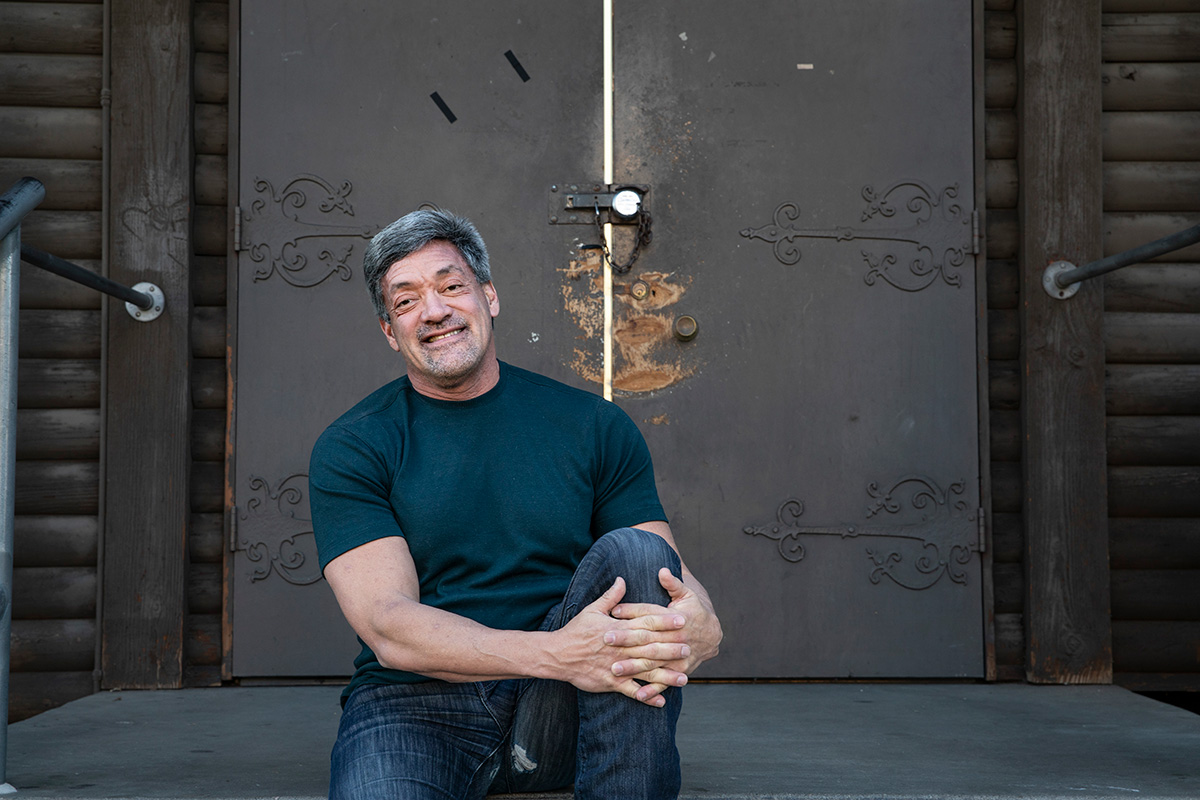
I was born and raised around Los Angeles—in Lincoln Heights, Glendale, and then finally the Santa Fe Springs area. I've been coming to West Hollywood’s Sunset Strip since the mid-seventies, when I was in high school with my little fake ID, getting into the Whisky [a Go Go]. I was Jose Gonzalez for many years. Back then, I had three girlfriends: Janet, Bonnie, and Lanita. I was not anywhere close to homosexuality at this point. As we drove through West Hollywood, my friends pointed out where the gay guys hang out—the Four Star, Blue Parrot, and Studio One. I didn't say anything, but they were basically giving me a roadmap for where to go.
I came back later with my fake ID, and I found Studio One. I circled for like forty-five minutes, not because I couldn't find parking, but because I tried to find the courage to tell myself that I wanted to be in this community. I walked up the stairs of the Backlot on Robertson, and once the double doors into Studio One opened up, it changed my life.
But I grew up Catholic, so I said, “I've got to save my soul. I'm going to go to a place that's all-American, where the kids are clean-cut and conservative. I'm getting a job at Disneyland.” That’s how I ended up living in Orange County. At the time of the Cityhood campaign, I was living in Laguna Beach [part of Orange County], but I would be in West Hollywood all the time. I was law clerking for Diane Abbott and Roberta Bennett, and through them, I met LGBT leaders David Mixner, Shelly Andelson, and Peter Scott—all these really influential people who would shape me for politics and all that. I was working with ACT UP—AIDS Coalition to Unleash Power—the Orange County Visibility League, and I had started the first LGBT Democratic Club in Orange County—the Eleanor Roosevelt Democratic Club. My political interests at the time were in managing the AIDS epidemic up in Sacramento. A lot of incredible ideas were created around the LGBT movement in these now-historic West Hollywood locations where we gathered to break bread, like Café D’Etoile and the French Market. Over at the French Market, people started talking about the need to create a permanent lobby to respond to the 1986 California Prop 64 [which would have quarantined people with AIDS.] That’s how the AIDS (Lobby for Individual Freedom and Equality) was born, and I became the cochair.
It wasn’t until my law office got vandalized, and the back porch of my historic Santa Ana home was set on fire that I decided to move to West Hollywood. That was 1990, and I said to my partner at the time, “I don’t mind battling these crazy people in court or in the capital [Sacramento], but I need to feel safe when my head hits the pillow at night. So I can work in Orange County, but we’re going to move to West Hollywood.” I knew Councilmembers John Heilman and Steve Schulte, and said, “It sounds like they're starting something new and exciting there, and I'd like to be part of it.” So, we picked up and moved to West Hollywood. That's how I got here—to live in West Hollywood.
I didn’t know many people when I moved to West Hollywood. I became pals with Jeff Prang and Steve Martin. I knew Chris Fairchild, a local attorney who came out of ACT UP. Chris asked me to take on his client, Bruce Boland, a West Hollywood sheriff’s deputy who got fired because the Los Angeles County Sheriff at the time, Sherman Block, claimed homosexuality was incompatible with law enforcement. I fought to get Bruce reinstated, which we did. That is how I first got involved in specific West Hollywood politics.
After that, Chris Fairchild came to me and said he wanted to create an independent West Hollywood Police Department because we knew the sheriff’s deputies were still involved in undercover stings of gay men for lewd conduct at the Pacific Design Center, and those arrests ruined a lot of people's lives; there were no out gay and lesbian deputies; and the sheriff’s deputies were denying patients their HIV drugs while they were in L.A. County jail. At the same time that we were working on a campaign to create our own police department, Measure AA, LGBT activist Wuzzy Spaulding and others were involved in a committee with the West Hollywood Sheriff’s Station to create reforms on a lot of these same issues. But Chris said he’d bankroll the campaign with his life insurance policy, so we moved forward and what became Measure AA was on the ballot in 1992.
We lost the Measure AA vote. It was forty-nine for and fifty-one against. It was better that we almost passed it—rather than get skunked—because Sheriff Block and a lot of the brass at the Sheriff's Department came and said, “Okay, what do you guys want [in West Hollywood]?” We actually came up with a list: lewd conduct reform, no more undercover cops setting up gay men for sexual scenarios, having LGBT officers as part of the department, having sheriff’s deputies participate in the annual Christopher Street West Gay Pride Parade, and continuing to work with the Sheriff’s Conference Committee on reforms. Looking back now, I hope both sides would agree the fact that we almost created our own police agency really forced the Sheriff’s Department to move more quickly on reforms.
I learned during the campaign that there were political factions in the City—that there was a very solidified political group of people that had been formed around Cityhood—who were loyal to City first and to LGBT issues and everything else second. Those of us who were LGBT first really didn't understand City politics back then. Councilmembers John Heilman and Abbe Land, who were friends of mine, opposed the police department because their focus was more about budget and fiscal responsibility, which were legitimate reasons. All I knew was that we had a problem between the LGBT community and the Sheriff’s Department. A few years after that, before marijuana was legalized even for medicinal purposes in California, I worked with the Sheriff’s Department to set up the first medical marijuana collective in West Hollywood. I knew the importance of medical marijuana use for people with AIDS—to help with pain, et cetera—and I sat down with Sheriff’s Captain Lynda Castro to get her blessing because we could do it in the shadows or do it with the Sheriff’s Department having some control over it. We worked things out and gathered almost a thousand patients.
I'll never forget September 29, 1991. People had been fasting at the Queer Village in West Hollywood at Crescent Heights and Santa Monica Boulevard, waiting for Governor Wilson to sign Assembly Bill 101 [AB 101 was legislation to prohibit private employers from discriminating against employees because of their sexual orientation]. That day, I got a call from the Los Angeles Times newspaper asking me for a comment on Wilson’s veto of the bill he had promised to sign when he ran for governor. I went, “What?” because we were all assuming we were going to be celebrating because we had been promised by Pete Wilson that he would sign the bill. The community was barely getting by on just grief and anger and tears and blood and sorrow.
So, I called Torie Osborn, who was the head of the Gay and Lesbian Center at the time, and we agreed to meet with Steve Bennett, who was the head of AIDS Project Los Angeles, and John Heilman, who was, I think, mayor that year, at the Queer Village. We got there and people were starting to mill about. There were probably about twenty, twenty-five of us there, and one of these kids with purple hair, three rings in the nostril, from the AIDS activist group Queer Nation just started screaming at us, “You suits, you sold us out,” because we had agreed to a watering down of AB 101 to get Wilson to sign it. That kid was right.
People started marching down Santa Monica Boulevard, and Heilman got the Sheriff’s Department to clear the road so we could safely march. ACT UP had drums and whistles. The march was getting bigger and bigger, and this was about 6 or 6:30 p.m., and it kept growing. I decided we should go all the way to San Vicente and Santa Monica Boulevards. We were now five hundred people. When we continued the next night, we were ten thousand people marching. And thus began a two-week period where wherever Pete Wilson went, he was dogged by us and got an orange thrown at him. People were just angry. And it really wasn't just that little bill. It was a whole period of political angst building up like kindling of all the death and the dying and the fundamentalists and the religious right and the KKK and all of this. That is all part of West Hollywood's history. I try to explain it to younger people now, that prior to HIV and AIDS, gay men and lesbians had absolutely no use for one another.
After the veto of AB 101, the Lobby decided to run our own candidates against allies in Democratic primaries for the Legislature. I ran against Assemblymember Burt Margolin in West Hollywood. After I lost, Councilmember Sal Guarriello and his wife, Rita, invited me over for dinner. They said, “You got thirty-seven percent of the vote against a Democrat, you should run for West Hollywood City Council someday.” I had dinner with them often. In a weird sort of way, Sal was one of my other introductions to City politics. I didn’t understand that by that time, John and Abbe and Sal and Rita were not on the same team. I just assumed everybody was on the same team.
When the 1997 City election came up, Councilmember Abbe Land decided she needed a break from City Council after nine years, and she and John [Heilman] came to me and said, “We'd like you to run for City Council.” I ran and I lost to Jeff Prang by a few hundred votes. I think Jeff won because he was a known quantity in City politics—he had been on City commissions. I was known just within the LGBT community.
Oddly enough, given that I'd come out of Ballot Measure AA and had sued the Sheriff’s Department a few times, after I lost for Council, Councilmember Paul Koretz appointed me to the West Hollywood Public Safety Commission. When Paul had an opening on the West Hollywood Rent Commission, I moved over there and became a volunteer attorney for CES, the Coalition for Economic Survival. I really liked the Rent Commission especially because it was quasi-judicial, and back then, we were actually deciding actual disputes between landlords and tenants.
I was ready to run again for City Council in 2001. I had been on two commissions and was a CES volunteer attorney. I had something I could put on a campaign piece, and I won that race. When I got elected, I said, “I want those rainbow flags from one end of Boystown all the way over to La Cienega, and I want the rainbow flags up every day of the year. That’s why Councilmember Jeff Prang and I put in the rainbow crosswalks at Santa Monica and San Vicente Boulevards. What we're telling people is that this is a place where LGBT people can find sanctuary whether it's December or it's April. I've had to change the name of the Boystown neighborhood on Santa Monica to “Historic Boystown,” because Boystown, of course, suggests male-only [the name has been changed to the Rainbow District]. Granted, Boystown has now evolved to the point where it's more mixed, gay, and straight together.
On City Council, I wanted to make sure the City was on a firm foundation. Looking at the numbers on paper, the City is economically prosperous, the budgets are extraordinary, and the surpluses are unbelievable. We could build a new library, new parks, and new parking facilities. I got the votes to quadruple the arts budget—and not just in urban design but in outdoor performances, live performances, as part of our economic business model. I also helped permanently establish the June L. Mazer Lesbian Archives at the Werle Building and create an AIDS monument [in West Hollywood Park]. I think the thing I did on City Council that I am most proud of is saving the West Hollywood Alcohol and Drug Recovery Center in the Werle Building. The Council was going to demolish it to extend West Hollywood Park for a Tiny Tot area. I said, “There are five hundred children in West Hollywood and I've got eight thousand drug addicts and alcoholics coming here for meetings. We can find another place for Tiny Tot.”
I think the single most important ingredient to the City's success is that it’s unorthodox, nonconforming, outside the boundaries, the whole notion of thinking of ways of doing things that have never been done before, in a way that people don't normally get things done that it is unorthodox, nonconforming, doing things that have never been done before. I think that’s what allowed us to be called the Creative City. But if we lost the rock and roll clubs on the Sunset Strip and Boystown in a really radical way, then I fear we will become Brentwood, no offense to Brentwood [a very affluent neighborhood west of the City].
West Hollywood has been my home for thirty years now. I've lived in the same rent-controlled apartment for twenty of those thirty years. Hopefully, it will be home for many generations of LGBT people to come, but I think it's also a place where anybody can come find sanctuary and where people can find a home where they wouldn’t fit in the mainstream. As long as West Hollywood has that, it’ll continue to be relevant.

