
Ivy Bottini
“In the beginning, the City was about saving lives—for the gay and lesbian community, for the renters, for seniors, and for the Russians.”
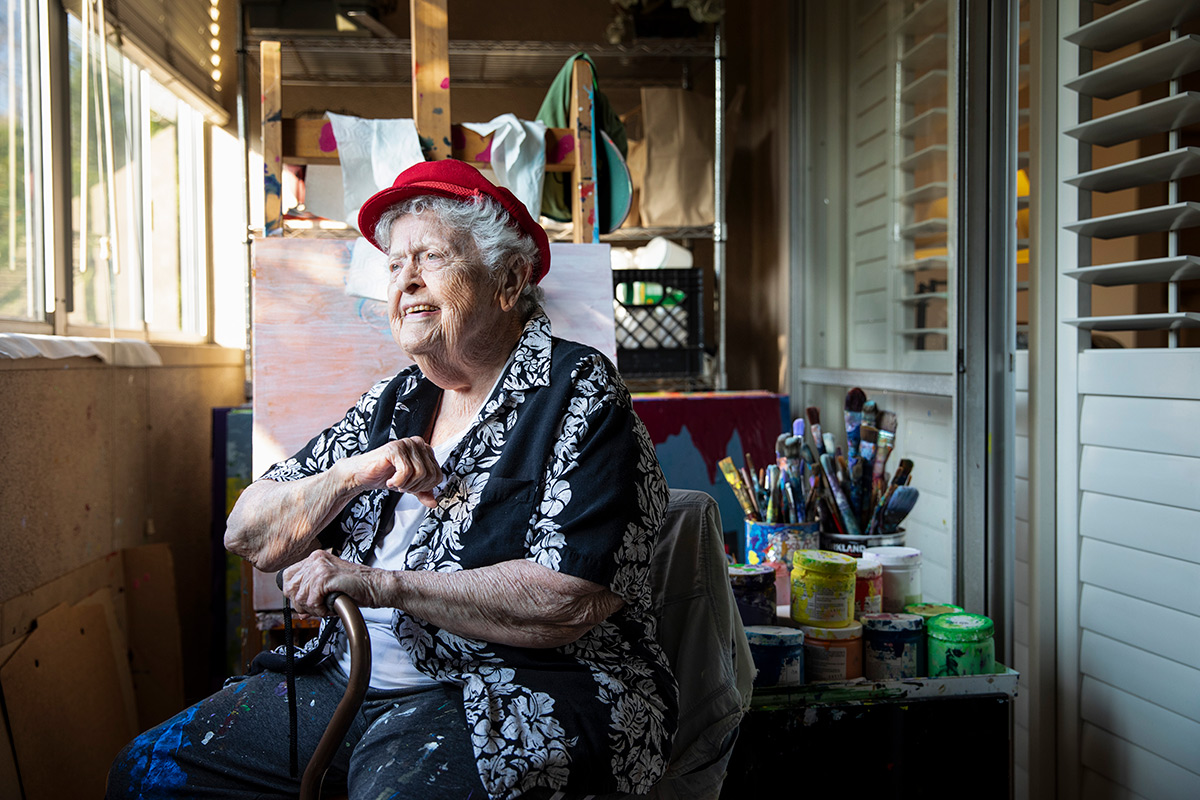
My mother did what women were supposed to do back then—raise kids. She didn’t have a chance at a better life because she didn’t. We were really poor. I think the reason I became an activist was because of my mother. I studied the arts at Pratt Institute in Brooklyn but was always inspired to create something for better people’s lives. In the sixties, I started in New York with the women’s movement and in 1966 was a founder of the very first chapter of the National Organization for Women (NOW) there.
My activism on the AIDS epidemic is how I ended up living in West Hollywood. I became a realtor, which supported my activism, and I was constantly driving from Silver Lake [in Los Angeles] to West Hollywood—sometimes back and forth three times a day. I remember I woke up one morning and I said, “I’m going to buy something in West Hollywood.” That day, I looked at three houses and bought the third one. That was in the early 1980s.
I was one of the first to believe that AIDS was transmitted through sex, through bodily fluids. Nobody wanted to talk about it, but after a dear friend died in 1982, I organized the first town hall in West Hollywood to discuss the seriousness of AIDS. I called up Dr. Joel Weisman [a pioneer in identifying the disease] and asked him to speak at the town hall so there would be an official voice on AIDS, not just my lips flapping. Years later, I was sitting in Joey’s Cafe in West Hollywood, and a man came up to me and said, “You don’t know me, but you saved my life because of the town hall you put together in 1982.”
Around 1983ish, some brilliant people got an idea to incorporate West Hollywood and make it a city. I knew about this being organized, but I wasn’t part of that push because those of us in the leadership of AIDS activism, that’s all we could think about. West Hollywood had already become a magnet for the gay community because the Los Angeles Police Department harassed gay people all the time, but the sheriff’s deputies, who policed unincorporated West Hollywood, left gay people alone. West Hollywood felt like our town, even though it wasn’t a city yet.
Right after Cityhood won, for me, it didn’t feel any different from one day to the other day. I knew we were now a city, which I thought was a great idea, and I was happy, but I didn’t really think about what would happen in the future as a city because for those of us who were in the leadership of the AIDS movement, that’s kind of all we thought of. There was too much to do. I was really focused on the people who were going through this horrible disease. People were dying. Almost every week there were funerals. Still, suddenly here I am in this kind of rough and tumble new city where people walked with joy, not fear, and not worrying what people may think of who they are. It was a very freeing feeling. People smiled on the streets. Everybody said hello to each other.
In the beginning, the City was about saving lives—for the gay and lesbian community, for the renters, for seniors, and for the Russians. I started paying attention to City matters. I personally spoke to the City Council about AIDS, but I started to notice there were things for the entire population that I could get involved in and my voice would be heard. There was a Women’s Advisory Board, a Senior Advisory Board, and so on. And then there were commissions, like the Planning Commission. I was amazed at how supportive the City was of its population. There was a lot of participation with straight people and LGBTQ+ people together. I guess one of the good things in the City, that you don’t necessarily find in other cities, is that LGBTQ+ community and straight people worked together and we talked about who we are—although straight people never say, I’m straight, because it’s an assumption that’s made, but LGBTQ+ people identify ourselves, and when necessary, people say they’re Jewish or they came here from another country—like the people from the former Soviet who came here for safety or a better life.
We’ve got something of everything in the City. We’re kind of like a goulash—all working together as goulash. I suppose there are a handful of people somewhere in the City that may not like lesbians. Who the heck knows? But overall, the vast, vast, vast majority of people in West Hollywood all worked together over the years. It doesn’t matter who we are. We are people who live in West Hollywood. That’s who we are. It’s amazing how the City comes together when any part of the City is under attack. We work in coalition. I have faith in the people who live here. I think they come up with new ideas. The City sees a need because the people are talking about it, and then the City comes up with something, like aging in place, so seniors can stay in their homes. I’m thankful for the City’s understanding that people get older and they have special needs. The City basically takes care of the elderly fairly well. I wish there could be some program to get the elderly who live alone out of the house more. I went to the Valentine’s Dance for seniors only two or three years ago. There must have been forty people there. That’s not a lot. They had a band, a real band, and then the next time I went to the dance, only about twenty-five were there. I don’t know. There’s got to be something for seniors to break that sitting in front of a television all day. I’m sure the City will come up with it.
Through my involvement with the City for decades, I brought issues out of the shadows. I always started with three or four people—people who were very committed because not every issue interests everybody. I remember one incident with two men in their late thirties, maybe early forties, who got into a domestic argument. One shot the other, killed him, and then turned the gun on himself. This kind of violence was never spoken about publicly, so I decided to bring it out of the shadows in the nineties as cochair of the West Hollywood Lesbian and Gay Advisory Board (LGAB). I said we’re going to call it “partner abuse,” because “domestic violence” is too much of a straight word. I had printed bumper stickers that said, “Partner Abuse,” and we had a booth in the Gay Pride Parade for it. I think it took about a year, and then the City took the issue on.
In 2015, it was bugging me that after a certain amount of time, nothing can be done about filing rape charges, so I wanted to change the statute of limitations on rape. At a press conference to raise awareness about rape and assault in the City Hall lobby, I went up to Councilmember Lindsey Horvath, I said, “Lindsey, do you think I should try and get the statute of the limitations changed? Do you think it could be done?”
She said, “Maybe.” So, Lindsey got us a meeting room, and I invited the women who were like movers and shakers—the ACLU, the National Women’s Political Caucus, and all those. Then, in 2016, we went to Sacramento and got the statute of limitations changed. When it came right down to it, it wasn’t that hard. We just walked into the State Assembly with our signs. We were rowdy, but respectful.
Another thing I am proud of is helping to make a Transgender Advisory Task Force. When I realized that even the City’s Lesbian and Gay Advisory Board, which I served on for fifteen years, had a lot of misunderstanding and prejudice against transexuals, I had the power to make a task force. I’ve always felt very good about that. I lobbied very hard for a building for lesbian archives in West Hollywood. Oh gosh, I lobbied for that for four years. Other people did, too, and we got the June L. Mazer Lesbian Archives in the Werle Building [housed with the One Institute and West Hollywood Recovery Center]. They even have an elevator now in the building.
West Hollywood is really on my mind all the time lately. I am about to leave West Hollywood. I told my daughter I’d move to Florida and move in with her because it’s sixty-four percent less money to live there and my eyes are going—I can’t really paint detail anymore. When your eyes go, your independence goes. I feel awful about leaving West Hollywood. I’m leaving a huge family that went through struggles of this or that. Like when the lesbians didn’t want to work with the men and the men didn’t want to work with the women. Then our community was attacked by the Briggs Initiative in 1978. It was a ballot measure in California that would have allowed the firing of gay teachers on the spot, and we had to fight back together for the first time. Even a straight person could have been fired for supporting a gay person. And from that ballot measure, the LGBT community became more of a family of people with one purpose and that was to live in peace. Over the years, the camaraderie developed.
I am not sure what I’ll do in Florida. I always seem to be working on something that’s going to better people’s lives. I keep going because if there’s a door that just opened, I’m going to walk through it. Over the years, people have asked me to run for City Council and I’ve always said no because I want to be on the outside, so I can challenge power. I always fight back.

