
JAMIE ADLER
“I take pride in really setting the table for what West Hollywood is going to be like in the future.”
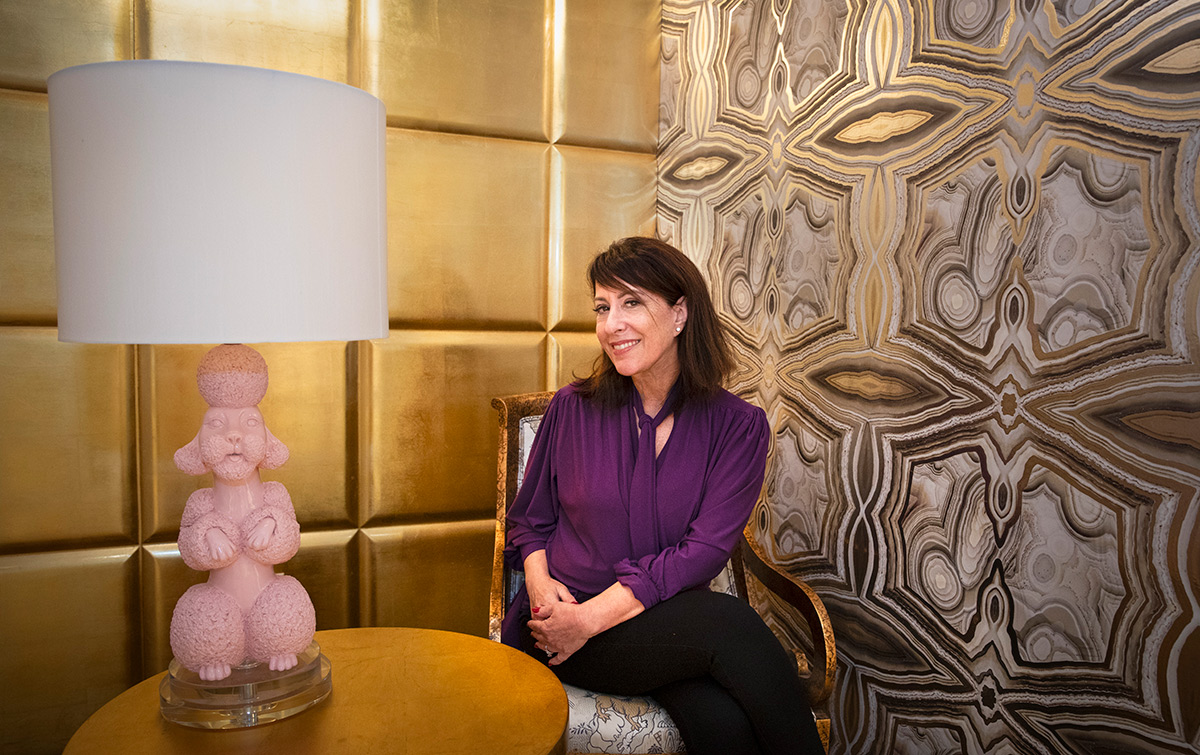
I think my mother, Phyllis Morris, wanted to be famous and probably realized that she could not be a movie star, but she could be a star in the furniture industry. She loved interior design and started off by designing her iconic poodle-design lamp in the 1950s, and soon after, opened a furniture factory on Robertson Boulevard when the street was auto mechanics and dye houses. She launched her first design showroom on Melrose Place in 1955 and moved it to a larger space on Beverly Boulevard in 1961.
Let's not forget, back then, the furniture industry was really a male-dominated industry. For a woman to come into the industry took a lot of nerve—chutzpah, as we say. I would like to think my mother helped pave the way for women in the design industry, and all of them were here in West Hollywood. She worked with a lot of the local merchants and visionaries to make West Hollywood a design capital—even before Cityhood. I think that having the Phyllis Morris Showroom on Beverly Boulevard—with her name and logo huge on the outside of the building—put West Hollywood on the map.
My mother saw West Hollywood as a diamond in the rough. I think she saw the potential for what it has become today. It was her belief and love for West Hollywood that gave her the courage to invest so big in it. With my father, Nate Goller, they started to buy property here, a little property there. They owned the Studio One property—one of the original centers for LGBT nightlife. It was a safe place for the LGBT community to go at night when the streets may not have been so safe for them. There was a Studio 54 vibe about it, and a lot of celebrities patronized and performed there. Luna Park was below Studio One, and it was an incredible, multifaceted music venue. My mom fell in love with the architectural intrigue of the El Palacio apartment building on Fountain Avenue and bought it in the early 1980s from the actress Pamela Mason. A lot of starlets lived there. I remember Maggie from Rod Stewart’s song “Maggie May” lived there. There were some directors, some writers, and then a few people who lived there a long, long time who were never going to leave the building because of the City of West Hollywood’s rent control ordinance.
I have been involved with my mother’s business since I could walk, I think. I always came to the showroom after school and walked through the factory with her when she’d inspect furniture. In my early twenties, I started working for her. There would always be real energy in the building. Sometimes, Bobby Short played piano. Celebrities like Barbara Streisand and Joan Crawford were customers. We’d have people come into the showroom, and we didn’t know if they were rock stars or homeless, and we had to just err on the side that they were rock stars, because nine times out of ten, they were. One day, a man came in with a brown paper bag. We thought he was one of those people who brought in lunch menus to shops. But when he came back the next day, he turned out to be a wealthy businessman from overseas who ended up buying a bunch of furniture from us. I became accustomed to things being a little weird in West Hollywood, a little different, and a little unpredictable. There really was something a little Wild West about West Hollywood before Cityhood.
After Cityhood, it was natural for my mother and me to get involved with the new City. My mother and I embraced the first City Council. There was something about the councilmembers, a kinship. It felt like they were on our team.
I could see that there was an evolution in West Hollywood that seemed to be happening in real time. It was as if all of a sudden there were people who were forming the City and looking after it, and nurturing it, and guarding the City’s boundaries. And you started to feel where the boundaries of West Hollywood began and ended.
I learned how important it was to be involved with the City. I would sit in on marketing meetings that my mother would have with Ron Kates, a commercial realtor/developer, and Tony Melia, who was head of the Chamber of Commerce in the City’s early years. Out of those meetings came the West Hollywood Marketing Corporation. And I served on the very first board of the West Hollywood Design District, which included the streets of arts and design in the City. We used to do art walks with all the design showrooms on Beverly and Robertson boulevards. The West Hollywood design community became so strong that the Pacific Design Center was built, and it drew a lot of designers into the building. Then, the empty storefronts nearby started filling up by the fashion industry. It was very interesting because there’s really no distinction between home fashion and apparel when they’re put together. It was an incredible mix of different businesses and different points of view. And restaurants started coming in. There were a lot of fiery personalities doing business in West Hollywood and the Marketing Corporation was able to leverage that.
Over the years, I’ve realized how fortunate we were to be in a city that allows its business owners to be its partners. I’ve seen the City Council listen to business owners at City Council meetings with such patience and compassion. I’ve seen some of the most high-end, recognizable faces in West Hollywood in front of the City Council speaking in a way that I don’t think happens in other cities. The accessibility of the City Council and the civic engagement that came out of Cityhood have been a real positive attribute of the City.
When my mother died in 1988, I took over her business. I believe I have a responsibility to carry on her legacy and make West Hollywood the best it can be. I want to be a cheerleader for the City and bring the community together. Today, I sit on Visit West Hollywood, the revamped West Hollywood Marketing Corporation, and I am on a City’s streetscape committee, where we’re looking at which trees will be going on Beverly Boulevard and Melrose in the next five years. While my mother’s poodle lamps are no longer manufactured in West Hollywood, they are shipped worldwide. So a piece of West Hollywood is living all over the world really—in cocktail table form, in lamp form, in chair form. People know that it was conceived here in West Hollywood.
Today, I see West Hollywood as a well-oiled machine sandwiched between the grittiness of Hollywood and the panache of Beverly Hills. I think it has an advantage that it’s still a young city that doesn’t have the antiquated rules and regulations that older cities have. That has allowed West Hollywood to remain true to the term Creative City throughout its evolution. So many trends started here—like the Pinkberry yogurt shop and Soul Cycle—and we’re on the leading edge of design and of culture and fashion. It’s as if the whole world is looking at West Hollywood without even knowing it.
I think people feel that coming to our City is a bit of an adventure. And it’s always interesting to me when I hear that people all over the world think one thing about West Hollywood before they come here but they don’t actually realize what it’s about until they get here. There is a misperception of West Hollywood that it’s strictly an LGBT city. I think that is a reputation we’re trying to shake. Not that we’re not proud of it because it’s one of our pillars and it’s a beautiful part of who we are, but West Hollywood is not a one-note city. I believe the LGBT community has created a culture that allows everyone to be accepted because if you can be gay, if you can be trans, and you’re accepted, you certainly can walk down the street wearing something that no one’s ever seen before. Here, you can offer an opinion that maybe no one quite agrees with, but there’s permission for that in West Hollywood. West Hollywood has always opened its arms to outliers and attracted all kinds of people.
I see West Hollywood like Mayberry—a small city with a big reputation. I think that combination makes us very interesting. I do think Opie may have been gay if he had come to West Hollywood. I don’t know. But he would have been okay here. That’s the thing about West Hollywood—there’s a place for everyone.
