
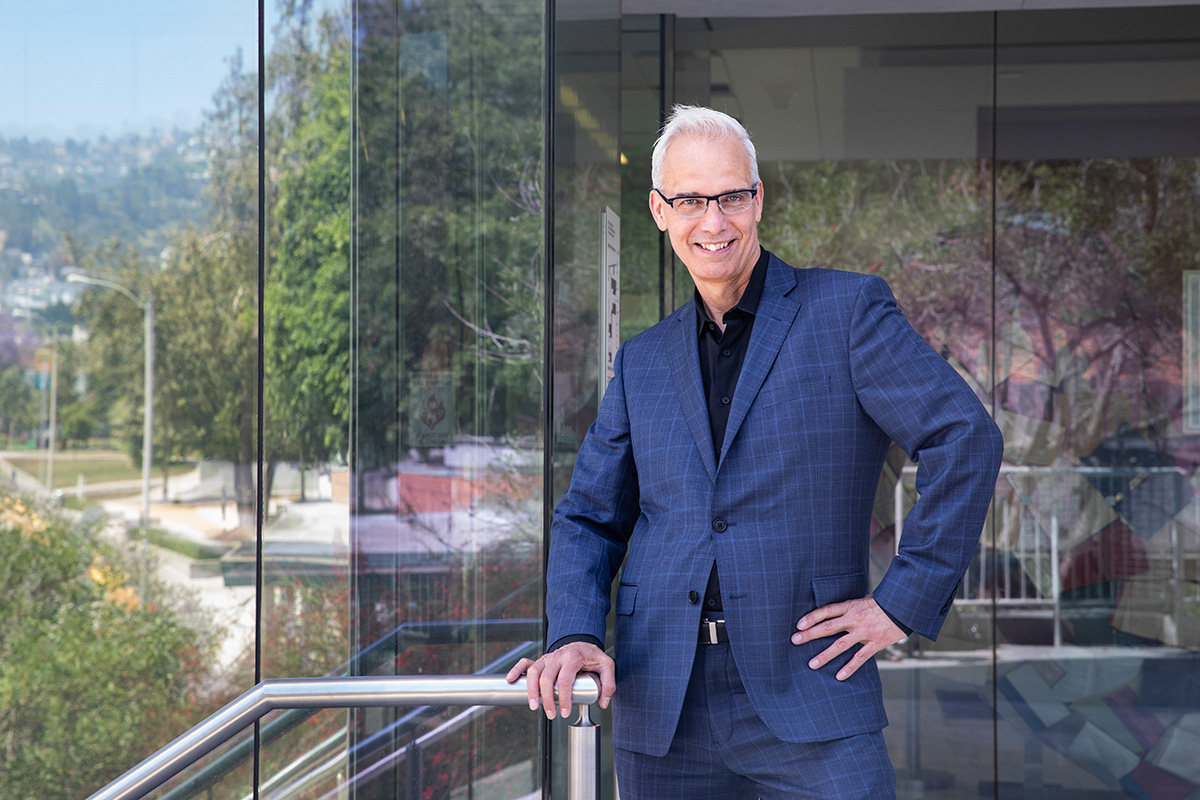
John Heilman
“Some of the landlords . . . would yell at us, call us Communists, and . . . say, ‘Go back to Russia.’
This was very funny since I had never been to Russia.”
Living in West Hollywood, we sometimes forget that people come here as a refuge. It’s a place where they can be free. Certainly, the LGBT community has that experience. I think some of our immigrant community has that experience as well. People come here, and they feel like this is the first place where they’ve actually been able to be themselves or not have to worry about some kind of Russian government crackdown on them because they're Jewish or Ukrainian. I think it's really a place where people feel this is their home, and this is where they belong.
A lot of people played important roles in making West Hollywood what it is. Some died shortly after Cityhood of AIDS and other diseases or just old age. There was Marc Bliefield from the Harvey Milk Democratic Club, an activist who helped with the Cityhood campaign. There were young volunteers like Jacqueline Balogh and senior volunteers like Frances Eisenberg and Harry Gottlieb, who was the first person to do constituent intake for the City when West Hollywood City Hall was in Plummer Park. Clayton Griffin was one of my City Council deputies—a gay guy who was living with AIDS, who spoke fluent Russian, and who understood the challenges City Hall faced with the Russian-speaking community because the government of the former Soviet Union had not been their friend.
My role in helping to create the City started with getting involved with CES [the Coalition for Economic Survival]. What first attracted me to getting involved with CES and fighting for their county-wide rent control ballot measure [Measure M] was I saw what was happening in the West Hollywood community in the early 1980s. People would buy apartment buildings, jack up the rents, and then sell the buildings, so you had tenants who were paying these high rent increases and not getting anything in return. That was a problem. At the same time, the Los Angeles County Board of Supervisors was controlled by a conservative majority, and they were phasing out L.A. County rent control. So where eighty-five percent of West Hollywood residents were renters, many of them seniors, that was going to have a really tremendous impact on our community.
Around the time CES’s ballot measure failed, a residents’ committee to explore Cityhood [West Hollywood Incorporation Committee, WHIC] was beginning, and they invited representatives from CES and the Harvey Milk Democratic Club to join. I was involved with both groups, and that’s how I got involved with the incorporation effort.
I don’t think there was one sole reason for Cityhood. Certainly, some of the people who started the Cityhood campaign were concerned about development decisions and that the L.A. County Board of Supervisors was permitting hotels in residential areas. There was also a growing LGBT movement, and the idea of electing openly gay people who’d adopt nondiscrimination policies and funding social services for the LGBT community was certainly a motivating factor as well. But the real motivation—what really elevated the campaign—was the concern over rent control and affordable housing and to have local control because the Board of Supervisors was taking our revenue and not reinvesting in the community.
The work CES had been doing in the community over the years really helped in gathering the signatures we needed to qualify for the ballot to vote on Cityhood. Once it seemed like Cityhood would qualify, Larry Gross from CES approached a group of us about putting together a progressive slate for City Council. It was to be Helen Albert, a Jewish senior and union activist; Doug Routh, who worked for L.A. County and had governmental experience; and me, someone who had a history of working on LGBT and renters’ issues. When I look back at the Cityhood campaign, the gay organizations were supportive, but the people who were really working hard on it were seniors. The idea that gay people would be working with Jewish seniors was not such a big deal because we had lived together, and we worked together on other things. The more challenging issue was that we had some landlords and homeowners who supported Cityhood but were more conservative than the tenants and the LGBT activists were on other issues.
Everyone on the CES slate, except Doug, won. Steve Schulte beat him. The average age of our first City Council was young. Alan Viterbi was twenty-two. I was twenty-seven. Helen Albert was seventy-three. She helped bring up the average there. Despite her age, Helen was amazing. I think sometimes people mistook the fact that she was very quiet for being manipulated, but she was very sharp and firm in her beliefs. She could just look with her blue eyes and see right through people—that absolute schoolteacher look she had. And there was Babette Lang, who served on the City Council a few years later. She was eighty. She had a great career as a psychologist and didn’t suffer fools well. Abbe Land and I served together for a long time in two different periods. People thought Abbe and I talked all the time before City Council meetings, but we rarely did. It was amazing how we would come to the same position on an issue because our outlook and our approach were very similar. What I loved about her was that whatever position she took on an issue, it was always based on what she thought was right for the City and the community.
The first months after Cityhood were certainly challenging. People were expecting so much from the City. Reporters from all over the world were covering us because we were the first city with an openly LGBT majority. As a City Council, we had to hire an interim city manager, do all the interviews for that, get a city attorney, and find a place for a temporary City Hall. We needed a rent control law, so we began to work on that. We wanted nondiscrimination laws. All of us had other jobs—except Helen, who was retired. At the time, I was practicing law. There were times we had City Council meetings until one in the morning. I’d have to go back to my office afterwards and stay there all night to get something done.
We also had all of these administrative responsibilities: setting up boards and commissions, creating the governmental structure, and hiring the people who you need to run a city. Fortunately, we did have people from L.A. County and the Local Agency Formation Commission (LAFCO) who had been around this process before to help us during what’s called a “free-ride period,” where L.A. County continued to provide services to the City but gave us its revenue.
Some of those first City Council meetings were raucous—certainly over how strong the rent control ordinance should be. I was on the council subcommittee that held hearings on the proposed rent control ordinance. Those hearings lasted hours. There were strong opinions among tenants.
The landlords were organized to oppose rent control. We had lots of debates, but I think it had to do with how people in the community were so committed to doing this right and making West Hollywood a model city. I remember that some of the landlords, who were themselves immigrants, would yell at us, call us Communists, and in very heavy accents say, ”Go back to Russia.” This was very funny since I had never been to Russia, so I didn’t know how I was going to go back.
When we passed the rent control law, a number of landlords painted their buildings red in protest. I recently talked to one of the landlords who protested in the early days, and he said that Cityhood had been the best thing that happened to him because the City’s success caused his property values to go way up.
I think because we were a new city, we really didn’t feel constrained by what had been done in the past. Many people in the City come from that progressive tradition of being advocates for the environment, human rights, equality, and LGBT rights, so it didn’t seem unusual that the City would be taking a stand on issues. But that is different from most other cities. I remember when we passed domestic partnership registration, a lot of people asked, “What role does a city have in relationships?” But then our ordinance was copied by a lot of other cities. And when we passed the ordinance prohibiting discrimination on the basis of AIDS or HIV, a lot of other cities copied that because there was really nothing happening at the state or federal level. We were able to show people the possibilities. It enabled us to kind of be a local experiment. All of the “horribles” that people predicted didn’t occur. Once people see that things like that work, it really lays the groundwork for more progress in other places and at the state and national level.
I think sometimes there is a false narrative that people who are progressive are not economically sound, fiscally responsible. We’ve proven that isn’t true. We understood that to have the revenue to invest in social services and cutting-edge programs—which most cities don’t do—and to be able to do all the things that other cities do—collect trash, pave the streets—we had to invest in local businesses and reassure them we were actually friendly toward them. The City Council developed a good relationship with the Chamber of Commerce. We started the West Hollywood Marketing Corporation, which evolved into Visit West Hollywood. Still, there were articles about whether a gay city could succeed. And we were worried about succeeding.
When we became a city, the economy [nationally] wasn’t great, and there were a lot of people who were very reluctant to locate a business or develop in West Hollywood. There was a lot of fear about AIDS, and the national chains were afraid of how being here would taint their brand in some way. Now everyone wants to be here. Businesses. Visitors. People want to live here. There is always something happening in West Hollywood. We have the Elton John AIDS Foundation Academy Awards Viewing Party. We have presidential candidates coming to visit our little city. You can see Angelyne in her pink Corvette signing autographs and selling them for $10. When we advertised that a famous Latvian singer was going to perform at our Russian Cultural Festival, people called West Hollywood City Hall in disbelief because they didn’t think someone so famous in Europe and Russia would be performing at Plummer Park.
We’ve had some interesting things happen at City Council meetings. There was the time that neighborhood activist Jeanne Dobrin spoke before the Council and said that her neighborhood was being overrun by “Ations: fornications, urinations, and defecations.”
I chimed in and said, “You forgot one, Jeanne: exaggerations.” That didn’t shut her up. Nothing did. Then there was the time somebody came to advocate for a new swimming pool in West Hollywood Park and showed up in his bathing suit. Jaws dropped in that auditorium. Of course, I voted for the pool.
What surprises me most about how the City has evolved is how we’ve become so economically successful. Our challenge now is the challenge of our success. Because of our investment in the community, West Hollywood is now seen as a much more desirable place than it was thirty years ago. As West Hollywood continues to evolve, it’s becoming more affluent, and this is the challenge of gentrification that a lot of communities face. We’ve tried to protect our residents by maintaining our rent control law and having a pretty vigorous inclusionary housing policy—new developments with housing have to include both moderate- and low-income units.
I think just in terms of our maturity as a governing organization, we’ve been through a lot of controversies over rent control, development, law enforcement. Sometimes, in the past, we would react immediately, and we now have learned that it's best to find out more details, not to jump to conclusions. For example, about twenty years ago, there was a building that was going to be used for sober living, and there was a big brouhaha over it in the community. I think the community now knows that change is inevitable, and the City has learned that the hysteria that is created about some kind of change turns out to be over nothing.
I certainly feel that I still play an important part because of my institutional memory. I feel like I can say what needs to be said that no one else will say, or my experience enables me to move away from the minutiae and focus on big picture issues in a way that maybe I couldn't twenty years ago.
I love this city. I love the sense that we can make things happen, and we can actually see the results of our work—our library, our parks, our [nonprofit] housing corporation that has provided a home for people who probably otherwise would be homeless. To be part of that is just so amazing and rewarding. After all these years on the West Hollywood City Council, I feel like there's always more to be done.

