
Margot Siegel
“I was looking for a place to live where they didn’t roll up the sidewalks at ten o’clock at night.”
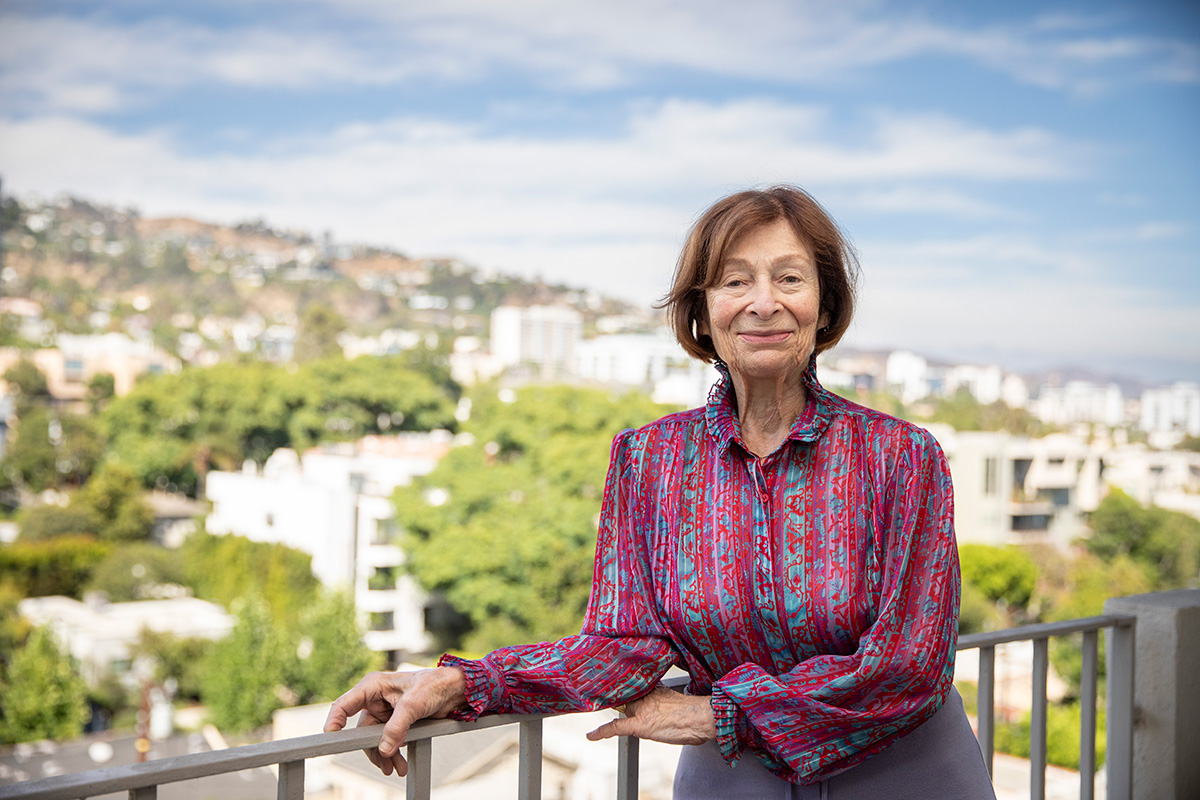
New Yorkers like me, we wear out our shoes, not our tires. So after my husband, Bud, and I got married in 1969, I was looking for a place to live where they didn’t roll up the sidewalks at ten o’clock at night. At first, I found a place in Santa Monica, but the rent was too high. I went to talk to the owner to see if he’d lower the rent, and guess who it was? The architect Frank Gehry. He wasn’t famous yet, but Gehry wouldn’t reduce the rent, so I kept looking.
I found an apartment that we could afford in West Hollywood—on Harratt Street, below Sunset. I didn’t know anything about West Hollywood then, but there were a whole bunch of really nice bookstores, and it felt more like a city than other places. Unlike other communities in the Los Angeles area, where walking was considered the behavior of unsavory characters [in those days], in West Hollywood, if I wanted to walk to the hardware store or the market, I wouldn’t get stopped by the sheriff’s deputies. I’ve lived here ever since.
Shortly after we moved here, in the 1970s, I heard about a West Hollywood residents’ group that was trying to advise Los Angeles County on planning issues here. That group is how Bud and I first got involved in the West Hollywood community. As an architect, I was asked to chair the group, but I didn’t have the time because I was just starting to build my own architectural business. Since Bud was good at organizing and loved politics—and he had statesmanlike abilities—I talked him into becoming the chair of the group, and I fed him the planning issues to raise at our meetings.
Around that time, L.A. County was required to come up with community plans for the unincorporated areas like West Hollywood. County staff were way behind with their work, and they said, “We’d be delighted if you give us a draft plan, and we’ll put in the proper language, and we’ll have done our duty.” So I put together a few people and said, ”Let’s draft what we’d like to see.”
The business owners in West Hollywood didn’t want residents advising L.A. County on planning issues because they were very happy to be able to do whatever they wanted. And the Board of Supervisors let them. For example, the Montgomery family, which owned property on Sunset Boulevard, organized strong opposition to any effort to establish even an advisory group that would have had any influence in this area. And when hotel owner Severyn Ashkenazy heard that our plan restricted hotels in residential neighborhoods, he started buying up properties. Bud tried to stop Severyn by convincing residents in Norma Triangle that if they downzoned their neighborhood to R1 [residential only] from R3 [single-family and multiunit residential housing], their properties would be more valuable, and Severyn could be stopped. By the time the zoning was changed, Severyn had already bought up many properties, and that’s why we have all these little hotels in residential neighborhoods of West Hollywood.
When it was time for L.A. County staff to approve our plan, they came to West Hollywood Park to meet with us. We’re a small community, so we were able to get people there by word of mouth, and we packed the room. The interesting thing—and I don’t know why—is that none of the business owners showed up to object to our community plan, and there was one hundred percent support for our plan among residents. The county adopted the plan, which remained in place for a bit after Cityhood.
Even with the plan in place, and even though previous cityhood efforts failed, we still wanted to incorporate to become our own city. We wanted control over the community where we lived. We thought that if we were self-governing, we could at least address the issues that L.A. County wasn’t addressing. We wanted the West Hollywood Park pool to be open more days of the year. We felt L.A. County wasn’t spending enough money on the Sheriff’s Department. We had a horrible problem with the clubs on the Sunset Strip. We had a parking shortage. And we wanted sidewalk seating at restaurants. When the L.A. County Health Department said, “No, you can’t have sidewalk seating at restaurants because people will get sick,” I said, “Look, people picnic in the park. They eat in their backyards, and they’re not getting sick.”
To move Cityhood efforts forward, some of us formed a group called the West Hollywood Incorporation Committee, WHIC. I thought we had to have a coalition in the WHIC. I know the importance of coalitions from my work as an architect because we work in teams on our projects. The WHIC coalition included gay activist Ron Stone, who became the chair of WHIC and was interested in local control in general. My husband, Bud, was on it. I wanted to be on it, too, but people said it wasn’t a good look to have a husband and wife on the committee. There was a woman who was an attorney, but I don’t remember her name. Eventually, the Coalition for Economic Survival (CES) joined because it was interested in protecting rent control. CES collected signatures from residents so we could qualify for the ballot. Bud had statesmanlike abilities, and even though the committee had varied interests and sometimes disagreed, he got people to work together.
When the Local Agency Formation Commission (LAFCO) claimed we would not be a financially viable city [a requirement for Cityhood] because the tax dollars weren’t there, Bud said to LAFCO, “Let me look at those figures.” Using LAFCO’s own numbers and their supporting documents, Bud showed that even under the worst conditions, West Hollywood could support itself. We were worried that the Los Angeles Board of Supervisors still wouldn’t vote to put Cityhood on the ballot, so Bud came up with the plan to persuade liberal Los Angeles City Councilman Ed Edelman to run for Los Angeles Board of Supervisors. Edelman got elected, and that’s when Bud did some more political maneuvering. He went to the conservative supervisors and told them Edelman wasn’t really in favor of incorporation and that they could embarrass him by putting Cityhood on the ballot. And they did.
Once the election was called for in November 1984, Larry Gross from CES took care of getting it passed by the voters. He had hundreds of people walking door-to-door campaigning. CES wanted to ensure that if we were going to be a city, there would be enough people on the City Council to prevent rent control from disappearing. Bud decided to run for City Council, and Larry Gross offered to support him, but he declined. Bud agreed with lots of Larry’s ideas, but he wanted to be independent and run on his own. Bud lost and later regretted not running with CES because he would have really liked to be on the City Council. He would have contributed a lot to it.
One of the first things the City Council did after incorporation was talk to the Sheriff’s Department to say, “We want to continue contracting with you, but you don’t hassle gay people, and you’ve got to work with the night club owners to control club patrons when they leave at 2 a.m.” The City Council encouraged people to participate in City matters—something you don’t always see in cities—and it created different resident commissions. Everybody wanted to be on the West Hollywood Planning Commission because it was so glamorous. Bud was on the West Hollywood Public Facilities Commission and helped develop the Kings Road pocket park and encouraged the purchase of the Santa Monica Boulevard median strip from Caltrans. I decided to go on the West Hollywood Transportation Commission because I figured traffic and parking were much tougher issues than planning issues. Traffic was a problem because when this area was first developed, with residential areas right behind commercial areas, there were fewer cars.
One of the things I did on the Transportation Commission was to recover several hundred parking places by simply taking the curb cuts out of unused driveways and extending the curb. We got office buildings to provide restaurants with parking at night. Now, when I walk around the City and see the parking spaces we have, I’m reminded of why we wanted Cityhood. As an architect, the most fun for me after Cityhood was seeing things actually get built, like the unusual parking structures the City Council authorized.
A lot of funny things happened on the Transportation Commission. Once, an architect came before us with all these beautiful drawings for the 9000 Sunset Building, saying his plan was better than what we wanted to do. When we said no to his plans, he said, “Look, I’m an architect,” and I said, “I’m an architect, too,” and told him all the reasons why his plan would be a really bad idea for the City and for residents. I was on the Transportation Commission for eleven years. Then, Bud got in a horrible car accident that left him a quadriplegic. I cut myself off from everything to care for Bud. But over the years, I’ve paid attention to what was going on in the City.
Nobody could have foretold how imaginative, forward-looking, and open West Hollywood would grow to be. I don’t know how that happened. It was just pure coincidence. There’s always stuff going on here. It’s lively, and it’s accepting as long as you’re not breaking the law. You want to wear purple hair, it’s okay. The people who got involved with making West Hollywood a city had that kind of spirit. In a way, it is like a small town. It’s more sophisticated than a typical small town, but it has that feeling. If I go to a hearing down at City Hall, I know all the councilmembers. I know the City staff because I’d worked with them and all of that.
My biggest surprise about the City’s evolution is that it turned out to be so socially aware and concerned. The City provides a lot more social services than just about any other place I can think of. It didn’t occur to Bud and me that great social services would be a benefit of Cityhood since we didn’t need them. The City has been very fiscally responsible, which has enabled it to do all kinds of improvements, like building a library and improving the parks. It’s just about the only city that never went into the red.
After Bud died, I said, “I'm comfortable here. I'll stay put.” I’d been a rolling stone all my life—Germany, France, New York, then San Diego and South Pasadena before moving here. West Hollywood is the place I’ve lived the longest. I know people here. I’m still involved here, but I don't have the energy that I used to. I'm eighty-six years old now. I think the City is in good hands.

