
BARBARA BAIN
“THE CITY SAID, ‘WE’RE GLAD YOU’RE HERE AND DO YOUR STUFF.’ WELL, WHO ELSE SAYS THAT TO ANYBODY IN ANOTHER CITY
LIKE WEST HOLLYWOOD DOES?”
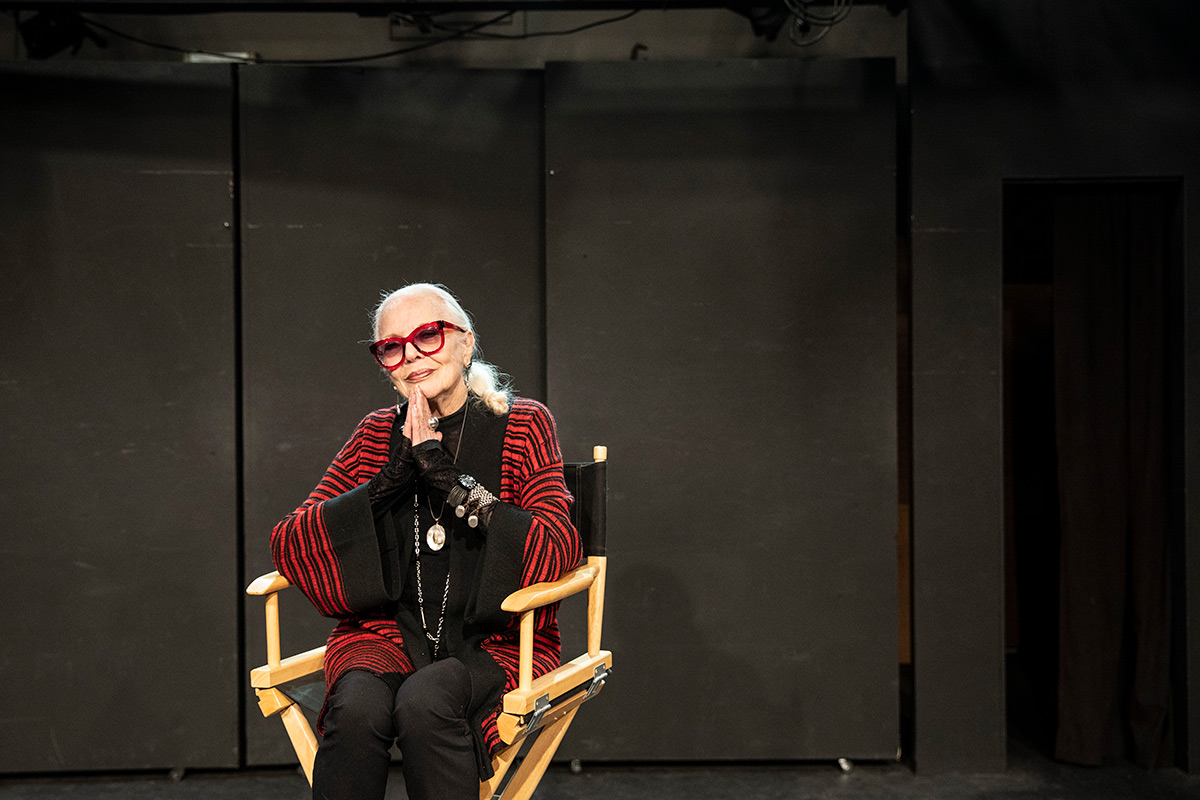
I was born in a car on the Outer Drive of Chicago. I attended Hyde Park High School and the University of Illinois. It was there that I found my first love, modern dance. That took me to study with Martha Graham in New York. When I first stepped on to the stage as an actor, it was under the aegis of Lee Strasberg. In that class, I met my future husband, Martin Landau, and we toured with the Broadway production of Paddy Chayefsky’s Middle of the Night. Twenty-six cities later, the tour ended up at the Biltmore Theatre in Los Angeles. If people weren’t speaking English in L.A., I would’ve sworn I was in a foreign country. It was so odd looking. There were no big buildings. You didn’t have to look up to see the sky—it was right there, right in your face. People were walking around in Hawaiian shirts, for real. I’m like, “Where am I?”
I’ve been here quite a long time. I’ve seen the birth of the City of West Hollywood and its spectacular growth over time.
By 1966, any number of us New York actors had come out here because there was a lot of work in Hollywood—TV was burgeoning. I was on the TV series Mission Impossible. We were all working, but we were bereft of a place to call home, like The Actors Studio we had in New York where we could try out material and further develop our craft. There wasn’t such a place here, so the first thing we did was form Theatre West, and we all got together and did scenes and talked about them. Then we got the idea to bring The Actors Studio here. There were so many of us involved, like Dennis Weaver, Lou Antonio, Jack Garfein, who was a director, Lonny Chapman, Martin Landau, and me. In those days, we used to sit after class at Norms, a coffee shop on La Cienega, and talk until four in the morning. We were a bunch of young actors—Robert Towne, who wrote Chinatown, and Jack Nicholson, and others.
The West Hollywood area seemed so exotic then. There were all those pipe shops and people wearing beads and sandals. Everybody was smoking pot, which I wasn't doing. I found it exceedingly uninteresting. I didn’t go much to the clubs. I did go to the Whisky a Go Go once on my way home from shooting Mission Impossible to watch a go-go girl dancer because I had to play one in the series the next day. It was research. I remember you could say anything as loud as possible there—vile or filthy— and nobody would know what you were saying.
One of us knew that the cowboy actor William S. Hart had written in his will that the building in Hart Park—then managed by the City of Los Angeles—should be used for theatrical arts. We negotiated with Los Angeles, and Actors Studio West was started in 1966, modeled after The Actors Studio in New York City. So Actors Studio West was already here when West Hollywood became a city.
In 1984, we were informed that the City of Los Angeles didn’t want to maintain Hart Park or the building where Actors Studio West was housed. We knew that the City of West Hollywood was considering more park space, so we met with the entire City Council about saving our artistic home. It’s all worked very well ever since. It has been a very nice coexistence. Everything about it continues to work, and it’s important for many reasons—especially the contribution that Actors Studio West has made to both theater and film, and the community.
Those of us with Actors Studio West felt very much cozier and more connected to where we were after Cityhood. The City acknowledged and celebrated creativity, which isn’t found much in the entire United States of America. You could be yourself in West Hollywood. You could invent anything you wanted. You could wear anything you wanted. You had all these talented designers here in the City, people who were making those boutique shops, and making beautiful things, and people were coming from all over to be here in West Hollywood. And the art galleries were here. All those things were saying, “Hello.” The City said, “We’re glad you're here and do your stuff.” Well, who else says that to anybody in another city like West Hollywood does? I think you’d have to celebrate the gay population for this, which is a creative population. You know, the gay population may only be thirty percent, but that thirty percent has been embraced by the City and that impact has been enormous. West Hollywood became known as the Creative City. In general, we have to fight for the arts in this country, but in West Hollywood, creativity and imagination are acknowledged as a good part of the human mind because without the arts, the human being is lost.
There’s a dynamic in the City itself. There is a sense of community, a sense of a small town. Lots of pedestrian traffic is one of the reasons you get the sense of camaraderie here. But steering the evolution of a new city was not easy when it’s hugged by major cities around it—Los Angeles on one end, Beverly Hills on the other. I think whatever the City Council has dealt with is pretty extraordinary. They built a new city hall. I watched the construction of the Pacific Design Center’s big blue whale. It’s an astonishing piece of architecture in our city. West Hollywood Park was redone. Building that new library in West Hollywood Park was critical. I was somewhat involved in the design of the new library. The City asked me to come look at some sketches of the children’s section because I created a reading program for children with the Screen Actors Guild called “Storyline Online.” I suggested, “Instead of having big blocks to play with, the kids could have some costumes and a small stage to play out stories.” In some odd way, I’ve had some effect, a little effect, on that room for children in the library. I actually knew the lady who ran the old library there, Betsy Mazursky. She was the actor Paul Mazursky’s wife, by the way.
Actors Studio West is helping the City plan the refurbishment of the Coast Playhouse on Santa Monica Boulevard, so the community will have a live, state-of-the-art theater. In a way, Actors Studio West is the best-kept secret of West Hollywood. There is no signage that says, “Actors Studio West.” I believe the City just wanted us to be here without waving a flag. I’m not sure. I know that West Hollywood is the right place for the Actors Studio West. There is something special in the City, in this room. I don't know if it’s the ghost of our man, William S. Hart, who wrote into his will this building should be used for theatrical arts. Yeah, maybe he’s here, smiling on the wall there.

