
Abbe Land
“That call totally changed my life,
though I didn’t know it at that moment.”
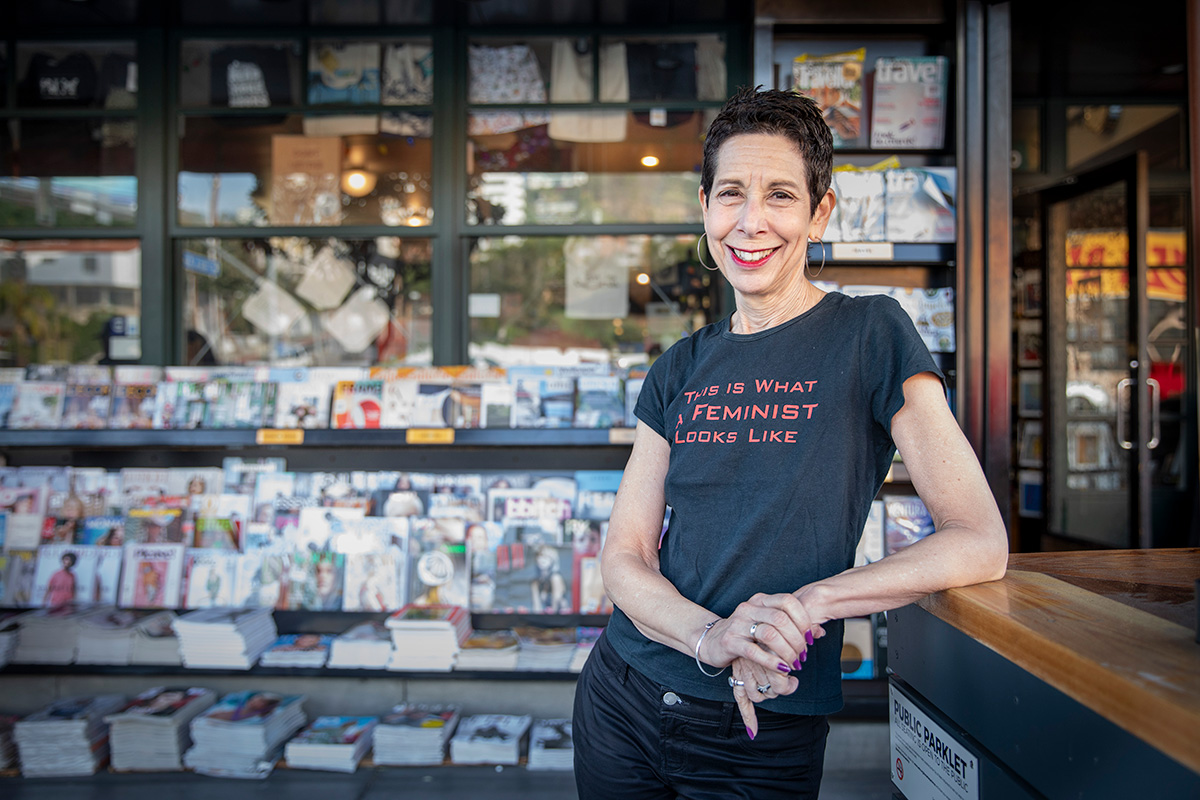
I grew up on the north shore of Boston in a town called Peabody. At the time, Jane Fonda and Vanessa Redgrave were making movies about social issues. People interviewed them all the time about their politics, so I thought if I were an actress, people would listen to me too, and I could make a difference in the world. I don’t always think of myself as an activist like Jane Fonda is—though I am. I think of myself as just wanting to make the world better, and I ask myself, “How can I get it done?”
The Coalition for Economic Survival (CES) taught me how to be an activist during the West Hollywood Cityhood campaign. I didn't say, “Oh, I’m going to learn to be an activist, let me call CES.” But in 1984, when I was doing what most people do when they’re going to be an actress—a lot of waitressing and odd jobs, trying to make ends meet—I got a call from Jacqueline Balogh, a CES volunteer. She asked me to volunteer on the Cityhood campaign. That call totally changed my life, though I didn’t know it at that moment.
I was not political back then, but I got involved in the Cityhood campaign because I thought we should live in a place where we couldn’t get evicted on a whim, and if I wanted to give my opinion on an issue, it’d be nice not to have to travel all the way downtown to the Los Angeles County Board of Supervisors to do it. I didn't really know any of the other volunteers when I first got involved, but the people at this CES were really nice. The director, Larry Gross, was a firebrand and believed so much in the possibility of West Hollywood becoming a little city with rent control and affordable housing.
It was exciting to be around all these people who were older. Chances are, I’m their age now, but they had been activists their whole lives. Some of them were even blacklisted during the McCarthy Era. Sometimes the older people volunteering on the campaign rolled their eyes at us younger people, but they were very supportive of the younger volunteers, including the lesbian and gay activists. I remember this woman, Ann Polsky. In my head, she’s three feet tall, but I think she was actually a little taller than that. She was in her seventies but had more energy than I did in my twenties. Like a lot of the CES volunteers, she was just relentless about rent control and housing. She had no patience for anyone who didn't care about those issues—but she was patient with me when I asked her stupid questions. There was also this woman, Nettie Mislove, she was very different than Ann, but as adamant about the issues. They were both inspiring to me. I hadn’t really known people like that before.
Political campaigns in 1984 were different than they are now. We actually had to dial voters from a landline phone that was plugged into a wall jack. We had to write out, stamp, and sort mailers by zip code—all by hand. We even drew campaign signs ourselves sometimes. On Election Day, which was November 6, we went out at 3 or 4 a.m., in pitch black, with door hangers to make sure our people voted. It seemed ridiculous to go out at that hour, but we were counting on people power versus money power to win. And it worked because Cityhood and most of our slate of renters’ rights candidates won. I was pretty euphoric after Cityhood passed and I said to myself, “Okay, I’m going to stay involved with CES.” It’s not that I woke up one day and said I didn't need to be an actress anymore, but suddenly I found this new way that I could make a difference.
I had a dream of making West Hollywood a place where you could afford to live; where, if you had an issue, you could talk to someone and get it resolved, or at least know they thought about it; where people could come together and have an interesting debate about things; where you could be who you are and everyone seemed to be okay with it. But I knew that things don’t happen because you sit down and just dream them, so I agreed to become a co-chair of CES. I would go to City Council meetings and say, “I’m Abbe Land, representing CES on this issue.” I really and truly was a CES girl. CES’ vision was my vision, and then I built on that vision over time.
When the City was forming its first commissions, it made sense for me to serve on one of them. I wanted to do something that’s not typical for women to do, so I applied for Planning Commission. I knew nothing about planning, but I thought if Helen Albert, a retired schoolteacher, was brave enough to run and then be on the City Council, I could be a Planning Commissioner. Bud Siegel and Bill Fulton were on the Commission, too, and they voted me chair because I was the only woman on the Commission.
When I got that first Planning Commission packet, I cried when I read it because, although I understood each of the words, I literally did not know what they meant in the planning context. But I learned by asking a lot of questions and listening to people who knew more than me. I remember those community meetings we had in Fiesta Hall at Plummer Park where we’d sit on the floor and draw on a map of the City and put what we wanted where—like parks and City Hall. That’s how we came up with the City’s first General Plan.
When just two years after Cityhood, in 1986, Mayor Valerie Terrigno was convicted of embezzlement and had to resign, I was asked to be the CES candidate to fill the seat. I decided to run not because it was glamorous, but to protect the things I believed in. But there was this guy, Gene La Pietra, who moved into the City and run against me. Gene was a wealthy gay philanthropist who brought in Midge Costanza, a Washington D.C. political player, to help with his campaign. They accused me of being homophobic and that pissed me off, because it wasn’t true. It was a pretty awful campaign, but I won.
During my first years on the City Council, we were still forming the City. We didn’t all agree on development as a community, and there were tensions between homeowners—who thought renters weren’t invested in the community—and renters, some of whom had lived here longer than some homeowners. But when it came to discussing domestic partnership, when it came to making sure that there was no discrimination for people who were HIV positive or had AIDS, everyone—the business community, homeowners, seniors—all came out to speak in support of those things. As a community, we shared basic values. It was amazing to be part of what became the model for the national movement that led to LGBTQ people having full rights to marry—not only here in America but all over the world. We even had a number of straight seniors, who might not have married because of inheritance issues, register as domestic partners because it afforded them certain rights—like visiting their partners in the hospital or jail.
Back then, elected officials in other cities wondered if West Hollywood could succeed as a city. So Councilmembers John Heilman, Helen Albert, and I decided to get involved in the municipal associations—the League of California Cities, the National League of Cities, and the Southern California Association of Governments. We were such novice councilmembers and wanted to learn what other cities were doing, but we also wanted other cities to get to know about West Hollywood’s work and to bring our progressive politics, like gay and lesbian rights and rent control, into organizations that primarily were more conservative. It was a time when people were still thinking you could get AIDS from a teacup or something, so we’d bring resolutions to these organizations about things like domestic partnership and AIDS.
Our strategy was to sit down at a table with other electeds, say from the South [of the United States], and let them get to know us. One time, Helen Albert and I are sitting together and the others at the table are trying to size us up, right? Helen reaches over and she starts stroking my arm, like we’re a couple, which we weren’t. I was doing everything I could not to laugh, but I’ll never forget how these guys looked at us, wondering why this older woman, Helen, was with this much younger woman, me. I think that by participating in these groups, we helped change some perceptions. We didn’t get all of our progressive resolutions passed there, but we did make a difference.
Many of our actions as a City Council looked to be symbolic. We declared ourselves a pro-choice city and opposed the war in Iraq. Our actions didn’t change what the federal government did, but they empowered people and raised consciousness in other places. When the media caught on to what we did, other cities said, “Huh, we never thought of doing that,” and they passed similar resolutions and laws. Suddenly, our actions were much more than symbolic. Another great example is when I cosponsored the Saturday night special handgun ban. Because West Hollywood had one gun shop—and knock on wood, we hadn’t had a gun violence incident—some people asked why we passed the ban. Well, guess what? Other cities wanted to get in on the action. Suddenly, we had a state law. I am enormously proud of that. When we banned polystyrene foam cups in this city, we were just one little city doing it. Someone needed to start it. And other cities followed. When was the last time you drank out of a foam cup anywhere? But the wackiest thing the City Council did, and no city has followed us on this one, was to keep City Hall open on Christmas Day. It was a compromise the City Council made when they voted no to Councilmember Alan Viterbi’s motion to make the Jewish holiday, Yom Kippur, a city holiday. The day after that vote, headlines everywhere were “City bans Christmas.”
Maybe it’s because we were so young and naïve that we didn't think we couldn’t do these things. But despite some of the less conventional things we’ve done, we made West Hollywood a city that functions. An amazing success. Everyone’s property has increased in value. The streets are not only paved, but there’s also a whole plan to keep them paved. Trees are planted. In the worst of economic times nationally, we built a library and started redoing a park.
We always invested in infrastructure, maybe because a lot of us at the time were renters and we lived in buildings where landlords didn't invest in their infrastructure. We always put money in savings—never spending everything the City had. When we had to raise taxes, we raised taxes because we knew we had to pay for social services. We were willing to make hard decisions, and we made sure that the development we approved was going to provide a tax base to fund the services we needed for the community. When I was on the City Council, I didn't support every development, but I supported hotels and restaurants, which generated revenue for social services, because that’s what our residents needed. When I had to choose between creating a new park and more affordable housing, I would always choose the affordable housing.
There are many things I love about this city. I love that we have these decades-old, family-run iconic venues on the Sunset Strip, like the Maglieris’ Rainbow Bar & Grill and Whisky a Go Go, and the Adlers’ Roxy Theater. I love that people can be who they are and feel safe, I love that I can walk to everything—to Trader Joe’s and Book Soup, our independent bookstore on the Sunset Strip. I love going to Pavilions and having people stop me to tell me about something they like, or they don’t like about the City, and seeing how I might help them. I used to joke that Pavillions should charge me rent because it felt like my second City Hall office. I love that when I see people on the street, I may not know them, or they don’t know me, but we smile and say hi because this is a community.
I was on the West Hollywood City Council from 1986 to1997, and then again from 2003 to 2015 when we had this thing called technology that helped me stay on top of both my City Council responsibilities and my full-time jobs as a co-CEO of the L.A. Free Clinic, now called the Saban Community Clinic, and then as Executive Director and CEO of the LGBTQ youth suicide prevention organization, The Trevor Project.
I don’t have a building named after me, but I hope people remember me as a person who really held to her principles. Who was always willing to listen. Who was always trying to find a way to build consensus around a policy issue. And who was a little part of helping to make this city a city. How many people get to do that in their lifetime?

